
The Age River is mentioned for the first time as “Adya,” meaning “shore” or “edge” in the Livonian language.
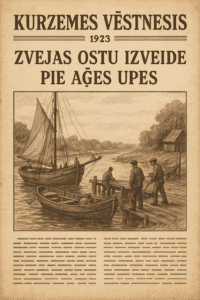
The newspaper "Kurzemes Vēstnesis" reported on the preliminary works for creating a fishing port near the Age River.
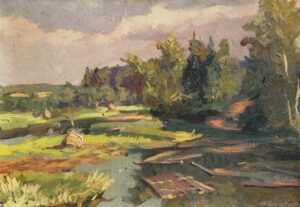
Uga Skulme painted the Age River in his artwork “Mouth of the Age River” (1959).
This piece is part of a series that includes other significant works, such as “Moment of Struggle” (1926) and “The Life and Struggle of J. Fabricius” (1949).
The banks of the Age River have been a popular location for landscape artists.
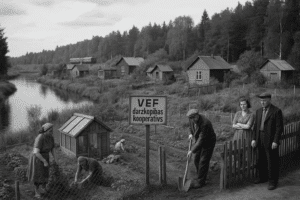
During the Soviet era, summerhouse and garden house villages began forming along the banks of the Age River, between the railway and the parish border.
These villages included:
VEF-Škulte, University, Kaija, Diāna, Mežvīns, Alfa, Nākotne, Saule, and Kolkliets – later incorporated into the administrative territory of Skulte village.
At the end of the 1960s, the State Electrotechnical Factory (VEF) allocated 600 m² plots to its workers, reflecting the era's social policy — ensuring workers had access to nature and their own green spaces.
However, this expansion faced resistance from the local community. Concerns included:
Environmental protection concerns – village development threatened the natural character of the riverbanks.
Access restrictions – public access areas near the Age River were reduced.
Construction disputes – residents objected to the proximity of new buildings.
Preservation of natural beauty – locals called to halt the project in order to preserve the scenic and ecological value of the Age River.
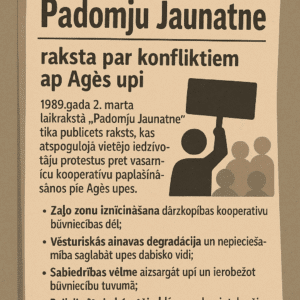
On March 2, 1989, the newspaper "Soviet Youth" published an article reflecting local residents' protests against the expansion of summer house cooperatives along the Age River.
The article highlighted several key issues:
Destruction of green areas due to the construction of garden house cooperatives;
Degradation of historical landscapes and the need to preserve the river’s natural surroundings;
Public demand to protect the river and restrict nearby construction;
Increased population density, affecting the environment and quality of life.

Today, the Age River remains important in the eyes of local residents and nature enthusiasts. Following past conflicts over development, many current efforts are focused on environmental protection and sustainable development.
Significant research has been conducted on water quality, which is generally rated as good. The river is regularly monitored to maintain its ecological status, and residents are actively encouraged to participate in its protection.
Current Priorities:
Maintaining ecological balance – controlling sediment and phosphorus levels, improving fish habitat opportunities;
Public involvement – organized forums, surveys, and community engagement initiatives;
Preserving the river’s natural values – particularly efforts to restore old riverbeds and protect the surrounding forest;
Digital platforms – the "Digital Age" project helps residents learn, share, and act for the river’s benefit.